
Commercial Radon Testing in Edmonton: Ensuring the Health and Safety of the Workforce
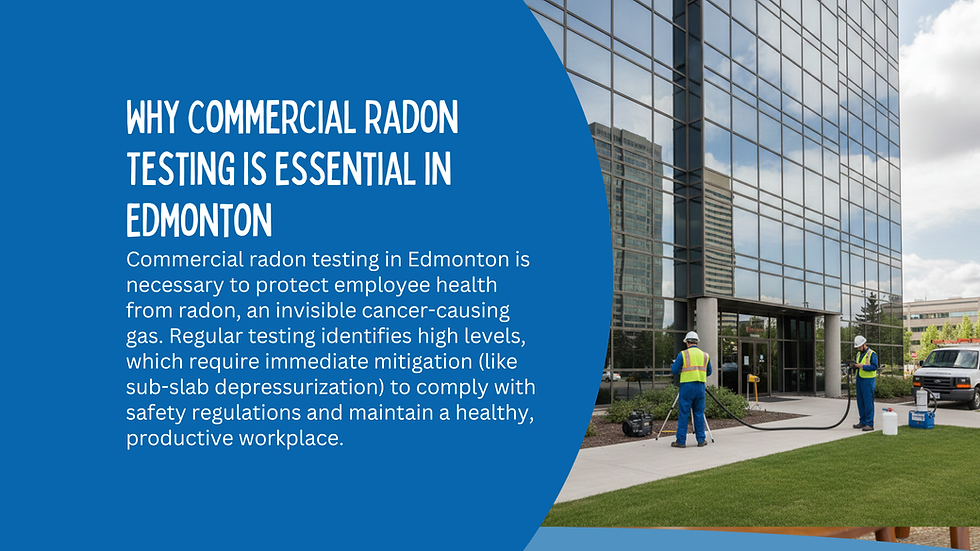
In Edmonton, workplace health and safety awareness is high — a key factor in promoting safer environments. Commercial Radon testing helps ensure the long-term health of employees while improving indoor air quality. Regular testing demonstrates a company’s commitment to maintaining a safe and healthy workplace.
Radon and Its Effect on Workplaces
Radon can enter businesses through foundation cracks, utility penetrations, or sump pumps. When Radon becomes trapped indoors, it can accumulate due to poor ventilation, increasing health risks — most notably, the risk of lung cancer. Commercial Radon testing helps identify elevated Radon levels before they become a long-term threat.
Every Commercial Radon Testing
Every business in Edmonton, from offices to industrial facilities, requires Commercial Radon Testing to detect and manage this dangerous workplace contaminant. Offices and workspace are less vulnerable to an avoidable toxin that diminishes productivity due to exposure to Radon, which is both unseen and preventable.
How Commercial Radon Testing Works
Commercial Radon testing involves using professional detection equipment to measure Radon levels in workplace buildings over a specific period. Businesses should test for Radon at least every five years, or after major structural modifications or new installations, to ensure levels remain within Health Canada’s recommended limits.
Interpretation of the Radon Test Results
Radon test results show how much radon gas is present in your workplace. If the levels are higher than Health Canada’s recommended limits, it’s essential to act quickly. You can improve ventilation or install a sub-slab depressurization system. Taking these steps helps your workplace meet air quality standards set by federal and provincial authorities.
Radon Mitigation for Offices and Businesses
If high Radon levels are detected, prompt action is essential. Solutions include sub-slab depressurization, enhanced ventilation, or building pressurization. Large commercial or multi-floor offices may require customized approaches.
Employee Safety and Workplace Compliance
Ensuring employee safety in Edmonton goes beyond what we can see – it means protecting against invisible threats like Radon gas. The practice of promoting and installing Radon measurement by the business reaffirms its commitment to the welfare of employees and being a frontrunner in ecological health accountability.
Radon Testing Cost For a Business
The price of commercial Radon testing varies according to the size and layout of the building. Considering the long-term benefits of investing in Radon mitigation, these include safeguarding employee health, preserving productivity, and alleviating costly remediation efforts in the future. Testing now ensures the safety of your work and business into the future.
Choosing an Edmonton Certified Radon Test Company
Hiring a certified commercial Radon testing company also guarantees practical approaches and true-to-life data. Great West Radon serves Edmonton and Calgary, Alberta, and surrounding areas, providing certified Radon testing and Radon remediation for commercial interests. Their priority is safety for the workforce, system reliability, and long-term avoidance, providing businesses with all the requirements to comply with regulations while maintaining a healthy indoor atmosphere.
Human and property risk of Radon
Ongoing monitoring and protection of workspaces (from Commercial Radon Testing) is a strong guarantee for compliance with federal/provincial safety guidelines. Continuous Radon testing and mitigation ensure that workplaces remain within the regulations, designed to keep people and property safe. By addressing Radon risks before they become a problem, companies protect employee health and safety, protect property value, and ensure business success.
FAQ
How frequently should Alberta businesses choose a Radon test?
Commercial Radon Testing should be completed every two to five years or following any construction that could alter building ventilation or damage the foundation.


Comments